
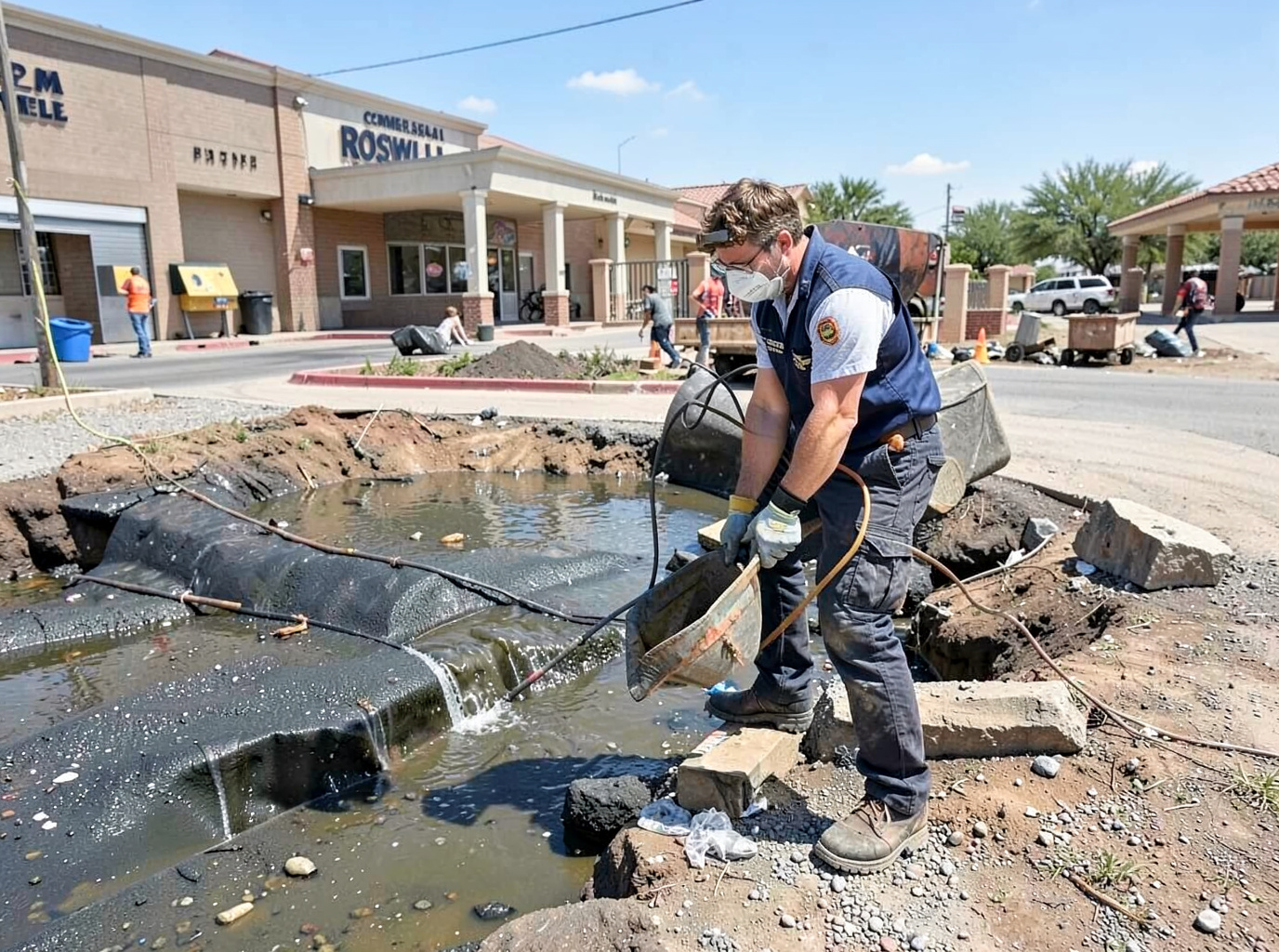
Commercial properties in Downtown Roswell and older blocks near the Walker Air Force Base Museum often sit on aging clay or cast-iron lines that crack under the semi-arid soil shifts common in Chaves County. When a main line backs up, waste can migrate under slab foundations and into wall cavities faster than in newer construction. Technicians must map the building’s original plumbing routes before extraction to avoid leaving pockets of contamination behind tile or concrete.
Hot summer temperatures in Roswell accelerate bacterial growth in standing sewage, while mild winters allow moisture to linger in wall cavities without freezing. This means crews working in North Park retail spaces or East Grand Plains warehouses focus on rapid moisture removal and HEPA air scrubbing to prevent mold on drywall and insulation. Local health rules require documented disposal manifests when hauling waste to approved Chaves County facilities.
Businesses near Spring River Park and Zoo or the Roswell Museum face extra challenges when backups reach public areas. Floor drains in kitchens or restrooms can reverse flow during heavy monsoon rains, pushing solids into customer spaces. Restoration includes removing affected baseboards, treating subfloors with EPA-registered disinfectants, and reinstalling finishes only after third-party clearance testing confirms safe levels.
Nearby cities like Artesia and Carlsbad send occasional commercial clients whose trucks or equipment travel through Roswell, sometimes introducing different waste streams. Crews adapt protocols for these mixed loads by increasing contact time on porous surfaces such as carpet padding and gypsum board common in 1970s-era strip centers.
Technician insight
In Roswell the thing that catches most people out with Commercial Sewage Backup Cleanup is how fast semi-arid soil movement shifts old clay lines under Downtown Roswell and Berrendo slabs. A small kitchen backup can travel under the foundation and reappear in an unrelated restroom two suites away before anyone notices odor. We always pull baseboards early and check the original 1960s–1970s plumbing maps instead of assuming straight runs.
North Park Retail Backup
A clothing store on North Main experienced a main-line reversal after a monsoon rain. Sewage reached carpet in two fitting rooms and migrated under the slab. We traced the line, extracted waste, treated the subfloor, and dried cavities before the weekend opening.
Commercial Sewage Backup Cleanup Services We Offer
✓Restaurant Grease Trap Overflow Cleanup
Remove backed-up grease and sewage from kitchen floors and drains, then disinfect surfaces to meet health department reopening standards.
✓Retail Store Flooded Restroom Remediation
Extract waste from sales-floor restrooms, treat porous materials, and restore operations without extended store closures.
✓Office Building Sump Pump Failure Restoration
Clear sewage from basements or utility rooms after pump failure and dry structural cavities to protect electrical and HVAC systems.
✓Hotel Room Sewage Extraction
Contain and remove waste from guest rooms or corridors, sanitize carpets and furniture, and return rooms to inventory quickly.
✓Warehouse Drain Backup Removal
Handle large-volume sewage from loading docks or floor drains and dispose of contaminated materials per Chaves County guidelines.
Commercial Sewage Backup Cleanup Cost in Roswell, NM
| Service | Typical Range | What Affects It |
|---|---|---|
| Small restroom backup extraction | $600–$1,200 | Single room, minimal wall involvement |
| Kitchen or multi-room commercial cleanup | $1,800–$4,500 | Larger footprint, possible subfloor work |
| Full warehouse or retail floor restoration | $3,500–$8,000 | High volume, disposal manifests required |
| Additional wall cavity drying | $400–$900 | Per affected wall section in older masonry buildings |
Ranges are typical for Roswell, NM and confirmed with an exact written quote before any work starts.
How it works
- 1
Site Assessment
Inspect affected commercial spaces, trace the backup source through existing lines, and document damage in areas such as Downtown Roswell buildings.
- 2
Containment and Extraction
Set up barriers to protect unaffected zones, then pump and remove standing sewage while protecting slab and wall integrity.
- 3
Cleaning and Disinfection
Apply targeted antimicrobial treatments to floors, walls, and fixtures, followed by HEPA air scrubbing.
- 4
Drying and Clearance
Monitor moisture levels in materials and obtain clearance before any reconstruction work begins.
Pricing
Upfront quotes after on-site assessment; final cost depends on square footage, contamination depth, and disposal requirements.